
by Lucija Furac, during the MIOB LAB of Cultural, Creative and Festival Journalism at the European Film Forum Scanorama
In 1946, English author George Orwell published an essay entitled Why I Write. His case is by no means exceptional. Many people reflect on why they do one thing or another, and many of those who write certainly write about writing itself. One thing is, however, characteristic of Orwell's essay and less characteristic of most personal essays – apart from his own, Orwell also lists every other possible reason to write.
While this may seem to be an impossible task, he asserts that there are in fact only four of them – when writing, one either succumbs to egoism, aesthetic enthusiasm, historical impulse or political purpose. Combinations of these four, Orwell suggests, are also possible.
Discussing contemporary film criticism at this year's Scanorama Film Festival Critics Workshop, the collective agreement among the participants was that the practice seems to have always been in a perpetual state of crisis. There has been no real "golden era" of film criticism, or at least no one ever offered valid arguments for it at the time. Its history has always been riddled with precarity and a lack of definite criteria, and regular prognoses of its demise. How come, then, that we still write?
It seems very convincing that Orwell's four scenarios indeed cover all possible reasons to write, for all time and on any subject. Different smaller reasons probably fall under the umbrella of one of the four main ones. To consider this makes a very amusing thought experiment indeed. Film critics specifically may write in the hope of bearing witness to film history, for example, but not make this intention obvious.
Their motivation may as well be completely mundane, in which they are, like everyone else, not immune to vanity. Without exception, all of them willingly draw attention to themselves by making their views known (hence, a degree of egoism). Often, they write with various theories and causes in mind, defending their own politics. Finally, all criticism is subjective, even when it employs criteria there is consensus about, and there are as many styles of it as there are critics and texts.
I, for one, believe that what gives value to film criticism is precisely its uncertainty. There is freedom in practices that are not limited by definite requirements or expectations. Even when there are conventions, seeing anything in one way or another is ultimately a completely autonomous and self-contained experience – what a joy! And reporting on it, no less so. If one aspect of current film discourse needs to be celebrated, it is the inclusion of an ever-greater number of voices within it.
From all the things one can write about and ask oneself for reasons to do it, little compares to the curiosity of writing about images. Man was made to make images of all kinds and to remain perpetually perplexed by them. Yet even as something is merely to be seen, the ceaseless call to write about it regardless must mean something. Images matter, so does writing about them, an act of ever-lasting discovery of oneself and the world.
Like many of my colleagues, I have many times fallen for images to the point of obsession. Cinema is enchanting in a unique way. It counts on the trust of the audience, it draws one in slyly. Once I started to watch films more consciously and having seen many of them, some of that magic was lost for me. At some point in my early- to mid-twenties, it seemed I went "blind" regarding images, no matter how wonderful they had once appeared to me.
It became hard for me to grasp the depth and value of them, and my relationship to film definitely changed. I did not believe there was anything to see anymore, let alone to say – the world seemed to be separate from the image, apart from it, while the image presented itself almost as a trap: a fraud, incredibly flat.
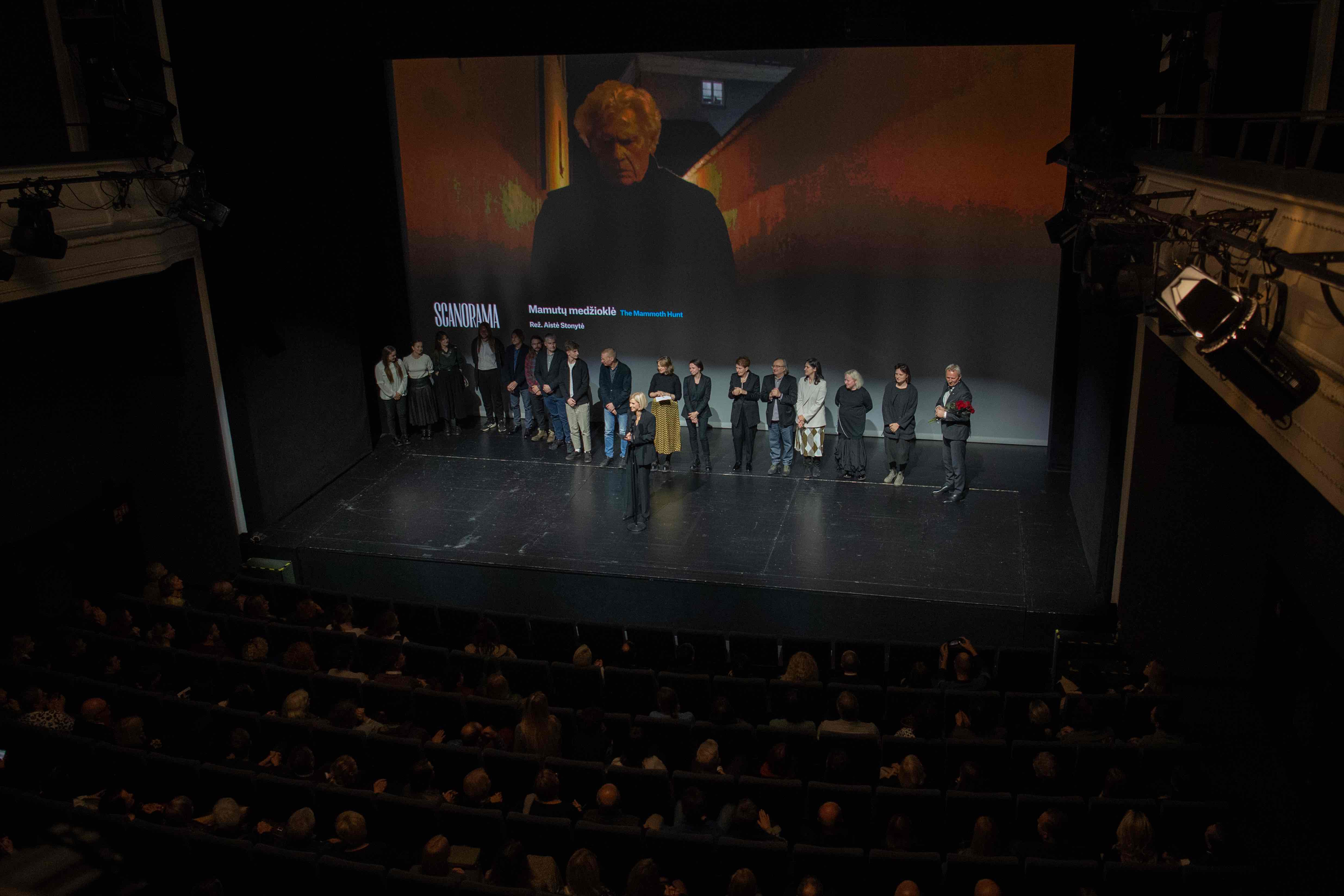
Thinking about the experience a few years later, it was a period in which I turned away from my selfish reasons to write, to use Orwell's vocabulary. In fact, seeing Aistė Stonytė's new feature-length documentary The Mammoth Hunt at the festival's Kaunas opening night helped me articulate this to myself.
This story about the lost recording of a banned play that Lithuanian director Jonas Jurašas wrote and staged at the city's drama theater in the late 1960s is a story about images that matter beyond an individual, beyond one's personal concerns or pleasure. The 16mm footage which no one was allowed to make but everyone knows exists somewhere, still hidden even in post-Soviet Lithuania, means something for the community and for the history which it wants to tell about itself.
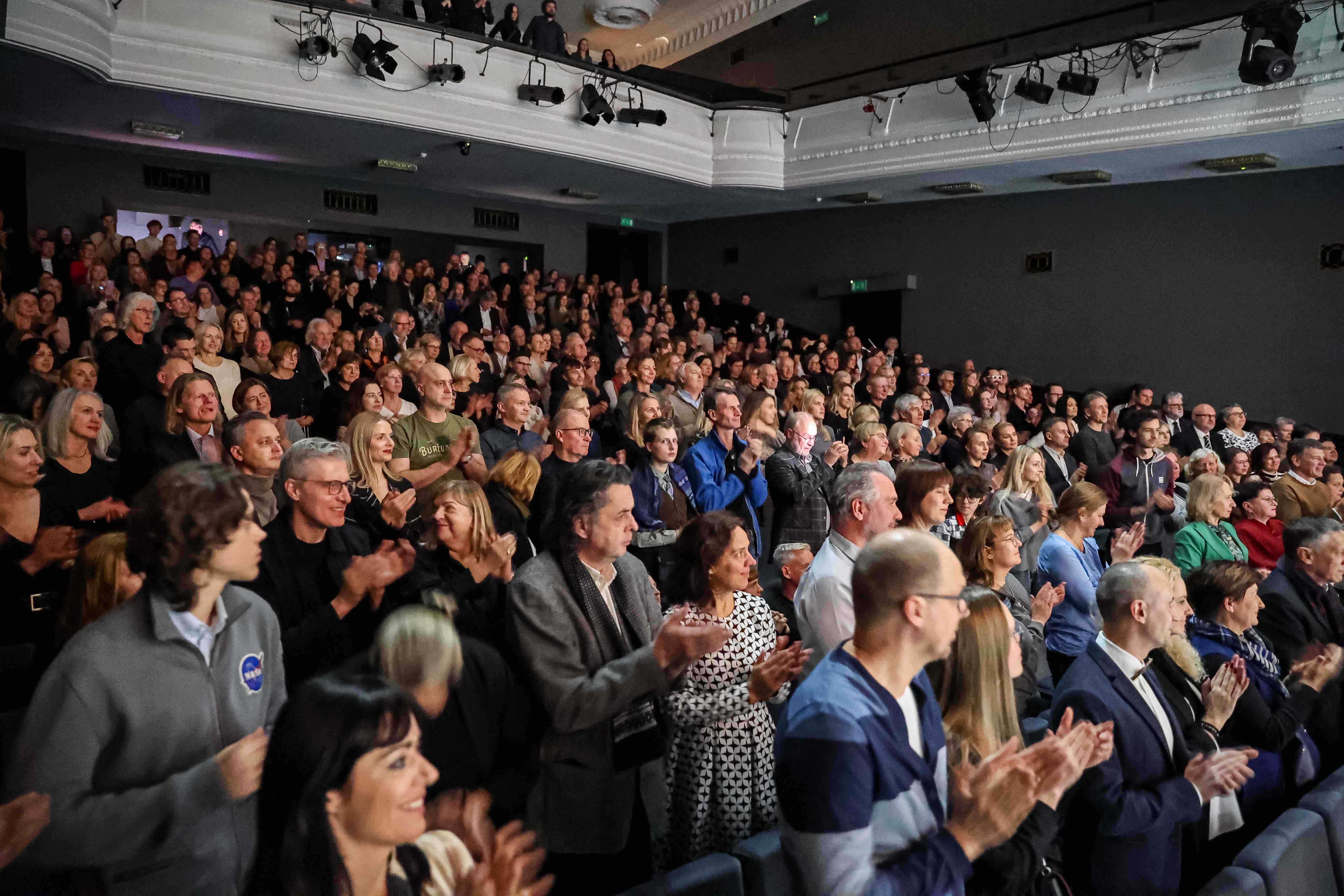
Images can be important in all kinds of ways and in cinema; they often have social significance. Like no other medium, cinema captures collective aspirations and myths, and its imagery is much more than a trifling affair. It can make the masses ponder, or even have access to dangerous things like freedom and change, to explore different uncharted territories, and open dialogues previously unimaginable. The atmosphere in the Kaunas theater during and after The Mammoth Hunt's screening confirmed that to me.
In my grim condition back in the day, it was so much more revelatory to discover the images that did eventually ignite a spark in me: new ones, different and unfamiliar. I am glad that enthusiasm returned in this way, again as something to see but also to write about in a fresh, more nuanced way, previously untried.
We write because we want to let others know what revealed itself to us. Despite the pricelessness of the images, they do not suffice. We want to talk about them. Our desire for images is never the desire for images themselves. The mind is still curious about something beyond itself and beyond the images, something they hint at – open within us something that both unites us and is greater than ourselves, our aesthetic enthusiasms, historical impulses or political purposes. It appears to me that it is nothing less than life itself.